Topic: Research Partnerships
Rethinking Chronic Absenteeism: Why Schools Can’t Solve it Alone
In Rethinking Chronic Absenteeism, Sarah Winchell Lenhoff and Jeremy Singer reframe chronic absenteeism as a symptom of a complex set of factors affecting the student, family, and community rather than simply an accountability metric for educators, schools, or districts. Lenhoff and Singer identify chronic absenteeism—often defined as missing 10 percent or more of instructional days—as an issue of social and economic inequality as much as an educational one, and they explore the role of K–12 schools and other organizations in solving this growing problem. The book is based on research conducted over eight years as part of a research-practice partnership with urban school systems in Detroit. Their results show the challenges of relying on school-based approaches to improve attendance, particularly in high absenteeism contexts where the causes of absenteeism are due to inequalities that are outside the scope of schools or districts to address. Purchase from our publisher and use code HCPR25 for a 20% discount: https://hep.gse.harvard.edu/9781682539613/rethinking-chronic-absenteeism/

Chronic absenteeism in Detroit’s Brightmoor neighborhood: addressing systemic & structural inequities through participatory action research
This study highlights the efforts of a Detroit-based community research group to understand chronic absenteeism in a way that acknowledges its underlying complexities. Employing Participatory Action Research, an intergenerational team of community members and university researchers examined the disconnect between educators’ strategies for addressing chronic absenteeism and students’ lived experiences with barriers to regular attendance. The findings reveal a school environment characterized by a punitive attendance framework that constrained teachers’ ability to address absences effectively and allowed school leaders to shift responsibility elsewhere. In contrast, students who experienced chronic absenteeism articulated a vision for improving attendance through specific structural pathways, school improvement, and social-emotional support. The discussion emphasizes the need for strategies that uphold students’ dignity and support educators’ capacity to move beyond punitive attendance policies.



The State of Detroit Schools, Students, and Families
This presentation was given in a series of State of the Schools events organized by our partner 482Forward.

Enrollment, Mobility, and Attendance in Detroit
This presentation for the State of Michigan's CEPI Longitudinal Data System Advisory Board showcased research on Detroit student attendance and mobility during the COVID-19 pandemic.
UCEA 2022 Presentation
Chronic Absenteeism in Detroit: Addressing Systemic & Structural Inequities through Participatory Action Research
Centering Community Voice in Chronic Absence Research: Detroit PEER’s Commitment to Participatory Action Research
This community voice post shares how Detroit PEER researchers worked with neighborhood groups in Springwells and Brightmoor to develop research into chronic absenteeism with community residents.
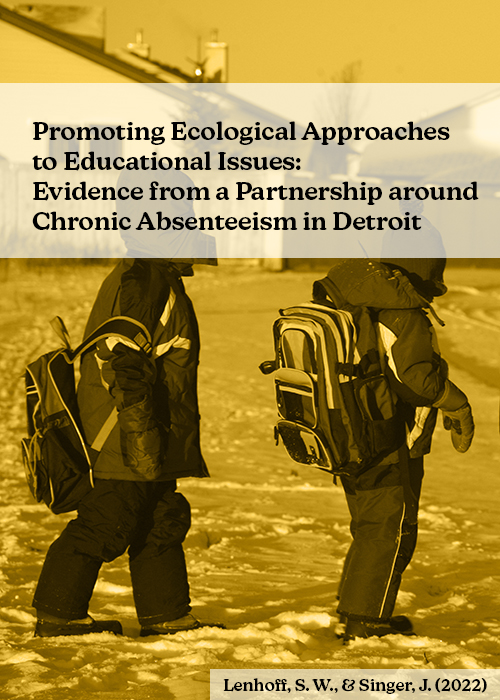
Promoting Ecological Approaches to Educational Issues: Evidence from a Partnership around Chronic Absenteeism in Detroit
Many problems that we conceptualize as “educational” have multiple causes that cut across students’ ecosystems. Yet, most education reforms are targeted narrowly at schools, educators, and students. Supporting educators and community leaders in conceptualizing educational problems from an ecological perspective and designing policies in alignment with that conceptualization is critical to improving student outcomes. This study documented the macro-, meso-, and micro-level institutional conditions that shaped how educators and community leaders conceived of the problem of absenteeism in response to research framed ecologically. Our findings highlight the challenges researchers may have in influencing ecosystemic policy solutions, but they also provide insight into potential pathways for doing so through research partnerships.
The Potential for Improvement Science and Research Partnerships to Maximize the Policy Relevance of School Improvement Research
Increased demands by policymakers for evidence-based practices and rigorous impact evaluations in education offer researchers an unprecedented opportunity to influence policy. Yet, academic research has an infamous reputation for not addressing the real problems of policy and practice, being difficult to understand, and being slow to adapt to changing circumstances in implementation. The increasing complexity of the educational policy landscape threatens to exacerbate the disconnect between researchers and policymakers. Researchers interested in school improvement cannot be content to describe and critique these processes. This book chapter describes our approach to policy-engaged research partnerships and the role of improvement science in internal and external work processes.